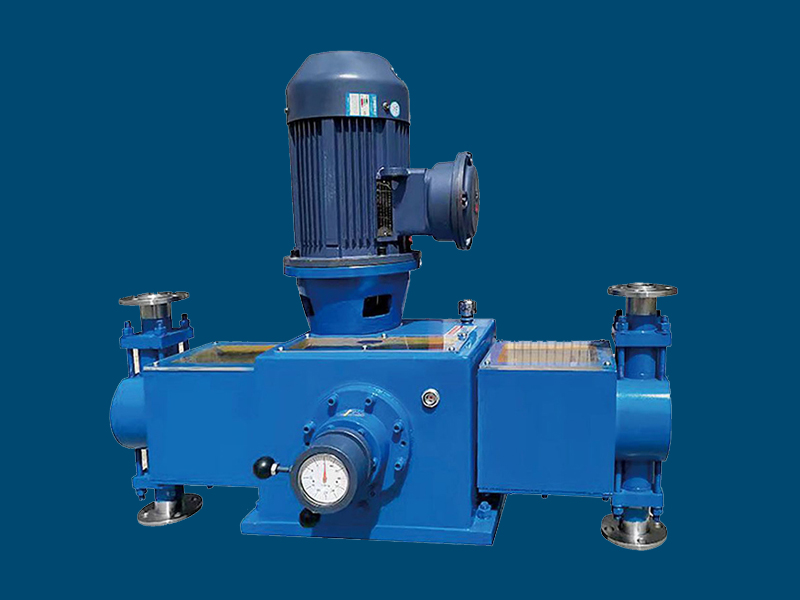
The plunger type metering pump (dosing pump) is composed of three parts: the motor, the gearbox and the pump head.
The gearbox components are composed of an arched crank cam mechanism, a stroke arrangement drive mechanism, and a transmission ratio gear set; by rotating the main shaft, a high adjustment stroke arrangement is adopted to change the front-back and left-right spacing of the arched crank, thereby achieving the effect of changing the stroke arrangement of the plunger (piston rod).
The pump head components consist of an intake valve/exhaust valve/plunger and a rotating seal.
The working principle of the plunger type metering pump:
The motor is driven by the coupling to push the vane and through the turbine to reduce speed, causing the main shaft bearing and the turbine to rotate. The rolling adjustment of the arched crank driven by the turbine performs repetitive motion. When the plunger moves backward, a vacuum gradually forms in the pump chamber, the intake valve opens, and liquid is sucked in. When the plunger moves forward, the intake valve closes, the exhaust valve opens, and the liquid is expelled during the piston rod's pushing motion. Under the vacuum state, reciprocating motion is performed and a continuous pressure is formed, and the liquid is quantitatively discharged.




 Home
Home